
Australia is a traveler’s haven. It has the best things the world can offer in one amazing continent. Here are the 10 best places to add to your list and roam, whether you are a native, an Australian citizen, or just a budding tourist.

Sydney Opera House
The flagship of Australian tourism and one of the most iconic structures in the world. This 20th Century masterpiece is home to 1,500 performances annually. The outside is lined up with restaurants, bars, and cafes. So if you’re not into operas, enjoying the drink and the view is just as fun.
Clocking at 2,300-kilometers, it is the largest coral reef system in the world (yes, it’s alive). It is a conglomeration of 900 individual reefs and 900 islands supporting thousands upon thousands of organisms. This World Heritage Site can be seen in outer space, too.

Ayer's Rock
You've seen sunsets on coastlines and metropolitan skylines, but witnessing it on Ayer’s Rock is otherworldly. Known as Uluru to the locals, this humongous piece of sandstone (yes, it’s just one rock) stuck in the middle of Central Australian desert stands at 348 meters with a total circumference of 9.4 kilometers. Like the Opera House, it is one of the most prominent icons of Australia.

Located in New South Wales, Blue Mountain’s most prominent feature is the Three Sisters, three protruding rock formations towering at 900 meters. Here you can trail, bike, or get your adrenaline pumped on rock climbing and abseiling. Not into extreme activities? You can enjoy the view the aboard the glass-roofed carriages of the Katoomba Scenic Railway.

Well, hopefully not literally. The 12 Apostles in Victoria is a collection of limestone vertical stacks that provide a magnificent contrast to the already pristine coastline horizon. The beach is bewildering on both early morning and sunset. Walk the shoreline. Take photos. Relax and enjoy the view.

For art lovers, there’s the Museum of Old and New Art in Tasmania featuring the impressive (that word is an understatement) collection of Australian art collector and businessman David Walsh. Described by Walsh as a “subversive adult Disneyland”, it houses many of the most controversial and infamous arts. If you like art-appreciation with heated debates, this place is for you.

If wine aficionados were to have a religion, Barossa Valley just outside of Adelaide would be one of the pilgrimage sites. With 50 wineries producing the best wines in the world, a wine-tasting tour beholds not only the eyes, what the with charming vineyards and the rustic ambiance, but satisfies the palate as well.
“AUSTRALIA HAS SNOW?” we can hear you blurting out. Just a three hour-drive from Melbourne, Mt. Buller is famous for skiers and those who are just looking for great sights to appreciate. With over 300 hectares of skiable terrain, the village and resort is complete with amenities such as chairlifts, t-bars, a toboggan park, bars, and restaurants.

New South Wales might be known for extreme adventure spots, but Melbourne is famous for gastronomic explorers. A melting pot of many culinary cultures from around the world, the thriving cosmopolitan has restaurants and cafes lining its streets such as Lygon, Brunswick, Smith, and yes, Chinatown Street. These places are every foodie’s haven.

Koalas are not the only celebrities in Australia’s Cuteness Department, it shares the spotlight with penguins, and most of them are in Philip Island. Just a ninety minute-drive from Melbourne, this wildlife park in Victoria is one of the largest colonies of little penguins in the country, with an estimated 70,000 in number.
Not everyone come to Australia with the intent of working a nine-to-five job. Some wants to earn a living with their own products or services, doing trade, or even acquiring a company.
So, how do you do business in Australia? We lined up the things you need to know in every situation for you.

Much like setting up shop on your homeland, establishing a business in Australia means you need capital, a concrete business plan, management skills, all the works.
But beyond those, you need to iron out the documents and processes necessary, such as (we provided the links for you for more details):

Australian companies grow in an opportunity-rich business environment, so it’s no wonder businessmen and investors would come and takeover some of the businesses here.
Companies here are all regulated by the Australian Securities and Investments Commission (ASIC). It holds a record of rules and supervisory documents regarding acquiring companies.
If you are interested in taking over a company (or companies) here, you may refer to ASIC’s regulatory index of takeovers and reconstructions.
Foreign investors and businessmen may begin by submitting a formal proposal, which will be subject to approval by the Australian Foreign Investment Review Board (FIRB). The board reviews and advises the Australian government if such proposals qualifies for approval under the government’s policy.
You may refer to FIRB’s Investment section page here for more details.

These days, growing your business means expanding your operations to a global level. If you are trying to register a foreign company with ASIC, here are the steps you need to do to help your affair going smooth.
After your registrations is completed, there are still some obligations that you have to fulfill, such as:
For a complete and detailed information for each step, you may check here.
 Listing for the Australian Stock Exchange
Australia, being a financial hotspot of the world, has a very active stock market. The main stock exchange in the country is the Australian Securities Exchange (ASX).
Australian and foreign companies may apply to ASX for listing, provided they meet the recommended requirements as prescribed by the ASX rules (you may check the listing rules here). These may include company disclosures and reporting requirements.
When it comes to migration, Singapore is up there with Australia on the top of mind list to settle in. The two countries are alike in so many ways. Both are former colonies of the British Empire. Both openly accept immigrants as part of their ever growing work force. Both offer high quality of life. And both are so different and foreign to the rest of the world, among others.
But when it comes to permanently establishing a life, which country really is the better haven? We’ve dissected what each destination has to offer. Because we know, choosing between the two can be a headache, too.
 Australia
Family friendly working hours. The Land Down Under makes sure their workers only toil for eight hours, and overtime is rare unless necessary. Working environment is remarkable. Compensation is good. The only let down here is the high income tax.
Professional work is very easy to find here. Getting a job in a short time is a casual occurrence. So unemployment is virtually a non-existing problem. Do note that employers may require local experience. They may offer lower base salaries, but the hefty bonuses usually make up for that.

Homes are very affordable, both in actual and annual prices. No wonder families will opt for landed houses than rent, unless accessibility to work plays in. Renting prices vary vastly. Though the apartments come in very high standards, the units are usually unfurnished, save for the stove and dishwasher. So budget is a huge consideration on both scenarios.
Housing here is the other way around. People tend to go for apartments and flats managed by HBD (Housing and Development Board), or settle for private condominium units. Getting a house is an option only the affluent can afford. But accessibility (not only to work, but to everything) is the biggest leverage here. Singapore covers only a small land area, so everything is just a few minutes’ drive away.
 Australia
Transport can be incredibly expensive in Australia with train and taxi fares hiking twice or even three times as much as in Singapore (despite the lower gasoline prices). The network of roads and trains are just as efficient and extensive, but getting your own car is a win as tag prices are two to four times lower here.
Commuting is a way of life here. Buses and trains are superb, and the tickets and passes are way cheaper compared to Australia. You can forget getting your own set of wheels, though. Like buying a house, it’s mostly reserved for high-income earners. Plus, you also have to shoulder the upscale gas prices.

If you enjoy cooking, dining at home is best in Australia. Fresh produce come in a wide variety and available everywhere. They might be expensive in some places, but you can get them by bargain in some. The fact that kitchen tools and gizmos are uber-cheap also makes dining at home the better option. Dining out is another story. Eating at restaurants and cafes can be pricey, reinforcing further the cook-at-home culture here.
Dining in Singapore is built on busy working life (which is not as lax as in Australia), so dining out is the way of life here. Inexpensive hawker centers and kopi tiam food courts are literally everywhere, from residential to business areas. More than half of the population run to these shops for snacks and nourishment, anytime of the day. The menus vary from store to store. They offer Chinese, Indian, Mexican, Japanese, Italian, and even Australian cuisine, you name it.
 Australia
Australia goes through four seasons in a year. Some cities even go through four seasons in a week. It becomes more diverse as you go farther, so you would need to do a bit of adjusting here. (To find out more about Australia’s weather and climate, check our blog here).
The world's only island city-state is just 277.6 square miles (compared to Sydney’s whopping 4,689 square miles), therefore the country experiences uniform temperature, humidity, and rainfall, most of the time. It thrives on a tropical rain forest climate and has no distinctive seasons.

Immigrants in Australia are eligible for health care benefits and housing grants the moment they become permanent residents. Beyond two years of stay, permanent residents can have access to social security. Once they’ve been granted citizenship, they can finally obtain an Australian passport, have their education fees deferred, work for the government, and even vote.
Being an immigrant here can be quite challenging. You cannot immediately buy a new HBD house, have access to government subsidies, and be eligible to most of the benefits you pay for in form of taxes. But once you obtain citizenship, things will start to go well.
 Australia
Australia has one of the highest income taxes in the world. Depending on your wage, it may deduct a huge chunk from your take home salary.
Singapore has very low income tax. But property and vehicle tax make up for that, which can be pricey,

Australian citizens and permanent residents are entitled for coverage by Medicare funded both by government and tax levy. This allows them to have access to general practitioners and hospital services, for very low, if not free, costs. (For more information regarding Australia’s heath care system, check our blog here).
Singapore has a non-modified universal health care system funded by the government. Although medical services are not provided free of charge, subsidies and price controls come into play to get the burden off the citizens’ back.
 Australia
Australia is a parliamentary democracy headed by the Queen of Britain. Freedom of speech is provided, criticisms against the government are allowed without fear of punishments, and elections are being held to appoint members of the House of Parliament from a two-party system (Check out here to find out what type of government Australia really has).
Like Australia, Singapore has its constitution and Members of the Parliament (the two were former British colonies after all, and therefore share the same government structure). But it is more stringent when it comes to freedom of speech, as it limits certain rights of the citizens.
Everybody loves holidays. But none love them more with such gusto than Aussies. These are the times when banks, some businesses, and government offices are closed, but with the tourist attractions open and the streets the busiest.
These are the times when the all too often busy folks take their time off, celebrate, and be with their family. But if your boss wants you to work on a holiday, not all is lost, because you’ll get a bigger compensation in return, usually 2.5 times, as a penalty rate.
Australian calendar is littered with holidays, and it usually varies from one state to another. But we will focus only on the eight biggest ones.

A New Year's Eve celebration at the Sydney Harbour
Much like the rest of the world, Aussies get high and ecstatic during New Year’s Eve. Once the midnight bell rings, everybody goes on party mode, and it goes on until sunset.
Balls are the norm of the day, highlighted with themes like formal wear, masquerade, or even tropical dress codes. And they aren’t picky with the venues either. Celebrations can happen on beaches, boat cruises, parks, or just barbecues at home. Fireworks are lit everywhere, illuminating the sky with the hopes and dreams of a better year.
But the focal point perhaps, is the countdown. Held in various cities, especially Sydney, this ends with a huge bang of grandiose fireworks followed with the hugs, kisses, and toasts of champagnes from the locals. New Year never look and feel this good anywhere else.
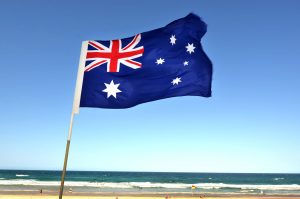
Australian flags are literally everywhere during Australia Day.
Most countries celebrate their nation’s inception during Independence Days, the time when they finally drove off foreign powers from their land. In Australia, they commemorate it by celebrating the time foreigners came into their land.
In 13 May 1787, a fleet of 11 ships commanded by Captain Arthur Philip landed ashore to establish the first British penal colony on Botany Bay, at the same time raising the flag of Great Britain at Sydney Cove.
Australia Day is the time of the year when Australians become more Australian. History and heritage are being celebrated. Flags are being waved and worn. Fun runs are being held. Twenty-one gun-salutes are being fired. There are barbecue parties, pride parades, costumed balls, and yes fireworks. Australian’s will find any excuse to have fireworks.

Hot Cross Buns are commonly eaten during Holy Week.
Aussies might always be partying and upbeat, but Holy Week is where things go lay low. Culminating on Good Friday, Holy Weeks is where people reflect, spend time with their families and friends (sans the partying), go on fasting, and pray.
Special church services and long prayer vigils are being held. Fish is being substituted to meat. Hot cross buns (small bread buns flavored with sugar and/or spices with a cross marking the top) are being eaten. Schools, post offices, shops, and most businesses are closed. Alcohol is tightly restricted also.
But still, some sporting events are being traditionally held on this time of the year, such as the Three Peaks Race in Tasmania, where people run, walk, and sail.

Egg hunts are still a popular game during Easter.
Australians are big when it comes to Easter. When most cultures end their Lent on Sunday, Aussies had to extend it until the next day. It’s basically the long weekend we all need, but only Australians apparently deserve.
Like in most countries, Easter is a reason to celebrate. Churches are lavishly decorated. Joyful songs echoes across the hall from the choir. There are chocolate eggs and Easter egg hunts, too.
On Easter Monday, business and school are still closed. It is the opportunity for people to spend time with their friends and relatives through reunions, family dinners, and community events.
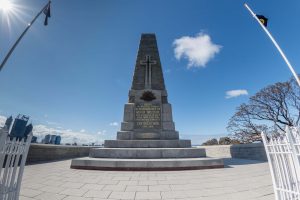
The State War Memorial in Perth, Western Australia.
Originally, this holiday is meant to honor only the members of Australian and New Zealand Army Corps, (or ANZAC, thus the name) who served and fought during World War I, battling the Ottoman Empire at Gallipoli, Turkey. But it was expanded to commemorate entirely all those who served in the military operations of the two countries. This is a rare occasion in which two sovereign nations celebrate the same holiday of remembrance.
The commemoration starts with the Dawn Service, in which people gather on the war memorials of each state or city with the chaplains, veterans, and dignitaries to offer a solemn and poignant tribute to those who courageously fought for the country. It usually ends with songs, flowers and prayers. You will never see a more stirring ceremony or remembrance other than this.

A young Queen Elizabeth as shown in an Australian stamp.
For the record, Queen Elizabeth II was born 21 April 1926, so the date of this holiday doesn't have anything to do with her actual birth date. Aussies celebrate whoever is the current monarch’s birthday ever since the late 1700s, and just moved the date to where it will be most convenient to them, regardless of what is written on the ruling king/queen’s birth certificate.
Like Easter, Queen’s Birthday is part of a three-day weekend. Shops and businesses are closed, and the roads are more congested than the usual, since people usually make holiday plans and go out of town. Public transport may decrease activity or not run at all. And yes, there are fireworks.

Labour Day Down Under is a three-day weekend
On 21 April, 1856, a group of building workers marched to Parliament House to make their plea heard: to be granted a fixed eight-hour working day with no loss of compensation or pay. Their call was heeded and became one of the very first organized workers in the world to achieve such privilege.
This inspired Labour Day celebrations around the world. A hundred years later, Australians commemorate this victory of the working class’ rights by… not working.
Like any three-day weekend, it is an opportunity for hardworking Aussies to sit back, relax, have barbecue with friends, drink wine, make holiday plans, travel, and spend time with loved ones.

There are no snow during the Australian Christmas, so sandmen are fairly common.
This may not need any introduction. Everyone in the civilized world knows Christmas. But we feel the responsibility to preface it. Because Yuletide down under is wildly different.
Christmas in Australia arrives during the beginning of summer season. Much like the rest of the world, Christmas trees (known as Christmas Bushes), lights, and the Nativity scene are a staple of the decorations. But this is where the similarities take a surprising halt.
Their Santa Clause, for one, is often depicted in pop culture as a bearded guy in a wide-brimmed hat, tank tops, shorts, and flip flops, riding a car pulled by kangaroos. Also, people build sandmen in the beaches, which is like a snowman, but made of sand.
But perhaps the largest event during this season is the Carols by Candlelight, which involves people gathering in a park, singing Christmas songs amid candle lights. And may feature performances from artists and celebrities.

Boxing Day all about gift giving. And mall sales.
If you expect crowds gathering around two blokes trying to beat each other to the pulp on Boxing Day, you’re in for a disappointment, mate.
Instead of trading punches, people exchange gifts or “Christmas boxes” on this holiday. Known as the ‘second Christmas,” this festivity was handed down to the Aussies by the Brits as part of their cultural influence.
But gift boxes aren’t the only ones flowing during Boxing Day, but shopping bags as well. Much like Black Friday in the United States, this Christmas Day sequel is also a time for sales and humongous discounts. Retailers would usually open as early as five in morning, clearing their gates for the long line of shoppers who mostly have been waiting since the wee hours of 26 December.
Much like the rest of the western developed world, Australia works on a multi-level of leadership and democracy. An odd combination of monarchy, parliamentary, and democracy working like a well-oiled machinery.
For some, this could be confusing, even an oxymoron of government category and functionality that is even impossible to exist. Here, we will dissect Australia’s political system and how it works.
A young Queen Elizabeth as shown in an Australian stamp.
As we have told you before, modern Australia was once a colony of Great Britain. Founded by the Empire as an exile destination for their ever growing number of prisoners, it worked hard to be a peaceful colony before being handed its sovereignty as an autonomous federal nation.
Autonomous, but not independent. The country is still part of the Commonwealth of Nations, countries which are former territories of the British Empire and still regards the British monarchy, currently reigned by Queen Elizabeth II, as the ruling queen.
This part is where the monarchist nature of Australia’s government ends, and where semi-modern democracy begins.
The Parliament House in Canberra, the capital of Australia.
As the prime element of Australia’s legislative branch, the Queen is represented by the Governor-General which serves as the de facto President and commander-in-chief of the country. The Queen appoints the Governor-General upon the nomination of the Australian Prime Minister.
Along with him is the Senate, the upper house of the country’s bicameral parliament. Each of the six states is represented by 12 senators (regardless of the population), making a total of 76 senators. After the reforms of March 2016, member of the senate will be elected through proportional voting system.
Completing this system of checks and balances is the House of Representatives of the lower house. This is composed of 150 members each representing electoral divisions or “seats”. These members are elected via preferential voting.
Australia isn’t just a monarchy, it’s a constitutional monarchy. Contrary to absolute monarchy, this form of government has the ruling power of the monarch restricted by the Australian constitution. And not just one constitution. The country has also six federal states, each one having their own constitution, barring each state from influencing, encroaching, and infringing each other. All in all, Australia has seven working constitutions.
Much like the rest of the democratic world, Australia operates on three levels of governmental functions, each one handling their own significant departments and affairs.
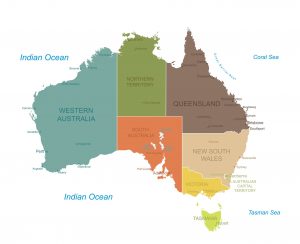
A map of Australia with its six states and other territories.
Headed by the Queen (represented by the Governor-General), the Upper House, and the Lower House, the Parliamentary Federal Government handles the Defense, Customs, Currency, and Immigration. It branches further more into three arms:
The Legislature – responsible for debating and voting new laws.
The Executive – In charge of enacting and upholding the laws instituted by the Legislature.
The Judicial – the government’s legal arm and in charge upholding the law.
Australia has six state governments; New South Wales, Victoria, Queensland, South Australia, Western Australia, and Tasmania. They each their own constitutions (save for the territories) and enact their own laws. They look after the police force, wildlife protection, schools, and hospitals.
Composed of boroughs, cities, towns, aboriginal shires, island councils, among other, there are a total of 561 local governments in the country. They enact their own by-laws and in charge of local functions such as town planning, garbage collections, libraries, and parking meter supervisions.
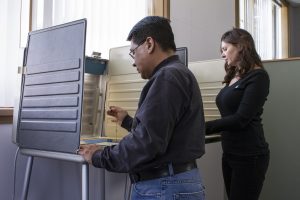
Elections in Australia are being held periodically to elect members of the legislature.
The Australian Parliament is the sixth oldest continuous democracy in the world, having hailed back to the beginning of the 1900s. And more importantly, it is the one of the best and most effective complete democracies in the world.
It is a country with an efficiently functioning government and outstanding culture of politics where civil liberties are duly and highly enforced and a competent electoral process. It has been this way for a century and will always be for many more.
We’re going out on a limb and say that Australia has the most efficient (if not the best) healthcare system in the world. What makes this effective is the funding model (albeit with divided political opinions) which dynamically and economically services people across all demographics and financial standing.
Regulated by the Department of Health and funded by both state and federal entities, the Australian health care is a two pronged system made up of the public and private health sector.
The public system is being taken care by Medicare which enable them access to GP (general practitioners) and hospital services. It provides financial assistance so that Australians can have low cost, if not free, access to medical and hospital care.
Under this, the government predominantly subsidizes the cost of medicines via the Pharmaceutical Benefits Scheme, a program of the government created for that purpose.
The Private system provides access to a private treatment in either a public or private hospital or specialist services.
But there’s a catch. To allow them to private facilities, they need first to purchase a private health insurance, which levies a 1% tax on them. This takes off the burden and frees more room for the lower and middle class citizens to take advantage of the public system.
 What Services Do I Have Access To?
The health care system enables citizens to have access on a wide range of services. In public hospitals, these include acute and moderately-acute care services, geriatric care for old people, palliative care for patients with serious illness, care for people with terminal illnesses, and emergency services.

Public health insurance is funded b by the government through Medicare. Instituted in 1984 and is administered by the federal government, it is additionally financed by a 2% tax levy on citizens earning above a threshold amount, and another 1% on high income earners without private health insurance. The rest is backed by the government.
If eligible, Medicare entitles citizens to a free treatment in a public hospital by general practitioners, free treatments by specialists if a GP refers the patient to a care plan, and claim benefits and payments for
 What Do Private Insurance Have to Offer?
Currently, only 46% of Australians have private health insurance which can be purchased from any of the private providers. Unlike its public counterpart, private insurance allows a patent to choose where they can be treated and by which doctor. These private practitioners are mainly out-of-hospital medical services. A third of total government expenses on health care goes to private insurance.
 The federal government shoulders the following expenses:
2. Other concessions or benefits the patient may be entitled to
3. Further benefits if they reach the Extended Medicare safety net general threshold, of which it will cover either 80% of the out of pocket costs or the benefit cap, whichever is the lower amount.
The remainder of the costs is then shouldered by the patient. Unless he/she goes for a bulk billing.
 The patient may have an option to have a provider bill Medicare directly for any medical or health service the patient receives, this is called bulk billing. In this type of arrangement, two things happen:
If a practitioner accepts bulk billing for a service, he/she undertakes to accept the related Medicare benefit as complete payment for the service. He/she cannot raise additional charges for that service.
Australia is a land of unlimited opportunities and a great quality of life. The fact that it remains one of the most popular immigration destinations in the world (at 6.5 million and counting) is never surprising.
But many are still bewildered, surprised, and disappointed that the country they landed on isn’t what they really imagined. The continent is physically detached from the rest of the world by the oceans which is the reason why it has a culture, political system, and a way of life different from the norm.
The periods of adjustments can be long and arduous. But in the end, it’s all worth it. The question is, do you have what it takes? Here are the top seven major challenges that immigrants face here.
 If you’re the type of person who frowns upon bills stealing your hard-earned money, Australia is not for you. As we have established before, it’s quite pricey to live here.
The continent is home to one of the most expensive transport systems in the world, and the only non-European among the list. The Internet isn’t cheap either, and you have a data cap to make things harder.
Everyday expenses from groceries to rent to restaurant to electricity and gas are also pricier than in most develop countries (like in the United States).
Well if everything is costly, at least getting your own house can be affordable right? No.

This might be the biggest challenge among the citizens down under, locals and expatriates alike.
Getting your own house is the best decision you’ll ever make in your adult life, but the prices and taxes here make that nigh impossible. Australia, along with New Zealand, is deemed to have the least affordable housing markets in the world. While the global housing value rises by an average of three percent, Australia tops that by a whopping 12 percent.
And it doesn’t help that homeowners here constantly over-valuate their properties by 47% to 57%, especially those who hail from Sydney, Brisbane, and Adeliede. Basically, the factors are working hand and hand here, and it is crushing the property buyers beneath as a result.

If you hate the sun, here it hates you more.
You see, the Australia is very much like Europe, if Europe was ten times closer to the sun. And it doesn't help that the country has a great outdoor lifestyle. Here, sunscreen is your bff, and you have to slap it on every few hours like your life depends on it.
Well actually, it does! The country has one of the highest case of skin cancer in the world. Protecting yourself from the sun is a must so you can continue living a good life here while elbowing the big C in the jaw.
And if you think the night is a safer time for you, it’s not.

Climate and temperature in Australia can be erratic, meaning daytime can be ultimately warm, and night time unbearably cold. This can get worse during spring, where evening temperatures can plummet down to 8° C from a 27° C during morning.
And we’re talking about the cities here, where it is relatively warmer. Outback and suburban climates can be much, much worse,
But nothing can prepare you for winter night. In Liverpool and Richmond, for example, winter evenings can dip below 2° C and even 0° C. This makes the temperature disparity between morning and evening even worse.
 Sure, getting out of the employment wheel and starting your own business is great career move, but the road can be tougher in Australia, especially if you need to hire manpower.
At $9.54 per hour, Aussies enjoy the highest minimum wage in the world (the very same reason people from all over the world converge here to look for opportunities). But if you’re still establishing your start-up, that means your employees will be getting a lion’s share of your capital. On the upside, you can be well sure you’ll be getting the best people.

If your idea of Christmas is a snow-covered yard, snow-ball fights, building snowmen, and anything snow-related, you’ll be in for a disappointment/surprise/ disappointing surprise. Yuletide here comes in the beginning of the summer holidays. Santa Clause might as well arrive in a surf board.
As opposed to a white, cold Christmas, the holiday here is more like your average Miami Bay vacation. But with lifeguards on Santa shirts and hats. And a decorated pine tree in the middle of the shore. Yes, it’s Christmas like you’ve never seen before.
It is warmer, the sun’s high, and it’s beach season. Forget the snowmen, sand castles are the December norm here.
 It is general knowledge (huge thanks to the Internet) that Australia is home to the most bizarre and deadliest creatures in the planet. From the salt-water crocodile to the box jelly fish to bull sharks, cassowaries, and eastern brown snakes.
These creatures mostly inhabit the Outback and the sea, though. Meaning if you stay at home, you’ll be out of these crawlers’ reach, right?
Well, not really. As the country has been suffering from pest problems ever since. Rabbits in Australia have been damaging crops and decimating other species since the early 20th Century. The government has been fighting invasive feral bees for long now. And then there are the spiders. The Sydney funnel web, mouse soider, and the Redback spiders alone are known to wander in backyards and swimming pools and even hide inside shoes and clothes. So it is always advised to check things before wearing them.
As we have told you before, Australia was a land both of challenges and opportunities, and it still is right now. But that doesn’t mean the costs outweigh the benefits, check out Top 10 Reasons to Live in Australia and see the beautiful side of living here.
The cost of living down under can be either pricier or more reasonable depending on which part of the country or the type of economy you came from. The mining boom in Australia brought forth stronger dollar value and higher economic upswing, resulting in fears of higher rents, over-priced food, and skyrocketing bill prices, usually driving away potential expatiates and immigrants.
But how much does it really take to live in Australia? We broke the down the numbers (and the rumors) here.
(You may convert the costs to your currency here.)
Cooking your food is always the most economical way for self-nourishment. Groceries for one to two people ranges from AU$300 to AU$800 a month. This includes the basic necessities like chicken, eggs, milk, cheese, tomatoes, apples, bread, and a few bottles of wine, beer and soda.
Of course, dining out from time to time can expand this cost. If you are fancy, a three-course meal for two persons in a mid-range restaurant can mount up to AU$80, while dining at a less pricey café can take you at a lower AU$18. McDonalds, always the most inexpensive eat out alternative, can take you only AU$10 for each meal.
Rent prices will always vary depending on your area of residence and the type of housing. If you are a student living near the campus, rent costs AU$320 to AU$1000 a month, while boarding schools offer them at AU$10,000 to AU$20,000 a year.
Sharing an apartment amounts AU$280 to AU$1000 a month, while home staying (in which you reside in a home of a local family) costs AU$440 to AU$1,080. With gas, electricity, phone and internet service ranging from AU$140 to AU$300 a month.
Living in furnished accommodations is another story. In normal areas, monthly dues for a 45 square-meter fully furnished place can place around AU$1,750, while an 85 square-meter apartment can cost AU$3,300. In expensive areas, this price can double. A 45 square-meter apartment can reach up to AU$2,500 while the 85 square-meter ones can worth AU$4,000. Other utilities and services can range from AU$190 to AU$200.
Unless you’re going for the tailored variety, dressing decently and comfortably in Australia doesn’t take much.
A Geoffey Beene long sleeve button front shirt costs AU$60 to AU$90, or you can take it up a notch and go for the Tommy Hilfiger brand which will cost you AU$120 to AU$130. A pair of Levis 501 jeans (or any similar variety) has a price tag of AU$100 to AU$110. While a pair of men’s leather business shoes rates at AU$130 to AU$160.
For the ladies, a summer dress from a high street commercial retailer (H and M, Zara, etc.) is just at around AU$70. While a pair of Nike or Adidas sneaks hovers around AU$133 to AU$145.
Roaming around the country is quite convenient and affordable because of its efficient transport system. Going by train costs AU$130 for a monthly ticket pass (or AU$4 for a one-way ticket). If you want a more comfortable option (without dragging your things and ruining your suit), taxi cabs are a great way to move around. Flag down rate is at AU$4 with AU$2.50 for every kilometer.
If you think commuting is not for you, a brand new 2015 Toyota Camry (or any likewise car) will cost around AU$29,000. Or you can settle for a used one (used car dealership in Australia is reliable and undergoes good quality control), for a mere AU$18,000. Gasoline is at AU$1.35 per litter.
Work here can be challenging at best, so you have to look and actually be healthy in order to function efficiently. For those sickly days, a box of antibiotics costs around AU$15, while Tylenol, Coldrex and other cold medicines hovers at AU$10. A quick visit to a private physician rates at around AU$63. To keep pushing the healthy lifestyle effort, you can get a gym membership, too which will land you at $92 a month.
For your toiletries, a 50 ml deodorant roll-on costs AU$5.30, while a 400ml hair shampoo and a tube of toothpaste is at around AU$6 and AU$4.10, respectively. Four rolls of toilet paper costs AU$3.15. And since you (or your guy) need to constantly look good and well-prepped, a standard men’s haircut costs AU$25.
All work and no play is not a very good way of living. You need to go out and unwind from time to time.
A general admission ticket to Australian Football League, the most famous sport in the continent, costs only around $25, though this price can change right up to game day. If you are not into sports, going for theater is another option, which will take you AU$237 for two tickets. Seeing a movie lands you at around AU$37 for two.
For bar crawling, a pint of beer costs AU$7 and a cocktail drink is at AU$16. Going for a cappuccino afterwards costs AU$4.12. A pack of Marlboro cigarettes costs AU$24.
Last year, the Australian economy spiked up by 3% on the heels of the impending mining boom end, further proving that the lucky country’s financial system is still the well-oiled machinery that it was, and can sustain almost any economic downturn.
And in an age where migration is a matter of survival, Australia is still one of the most popular choices to settle and retire, as shown by its increasing number of migrants.
So, what does the Land Down Under haveto offer? Here are ten of them:
Let’s admit it, when deciding on a new country to settle in, job opportunity comes high on the list. When it comes to this, Australia never disappoints.
At below 5%, it has one of the lowest unemployment rates in the world. It provides one of the highest minimum wages (even for the casual jobs) and is in constant need of a wide range of skills and specialization to support its ever growing economy.
The 2015 spike isn’t the first time the country endured an economic threat, either. It is in fact one of the very few countries that walked away almost unscathed during the global financial crisis that plunged the western world (mostly Europe) in a revolving door or economic slowdowns and declines.
Majority of Australians are considered middle class, largely due to its meritocratic philosophy, providing jobs to the young and old, in almost every strata of the society.
It’s very nice to settle in a country’s financial hotspot, where you have access to the best the city can offer. But most of the time, as the quality of living gets more lucrative, the crowd follows. Leading to a huge of people competing over smaller spaces, whether it is residential space, commercial centers, or even the cafeteria!
At three people per square kilometer, Australia is the 3rd least dense country in the world. And this still holds true for its major cities (no, we won’t ask you to settle in the Outback). Even if its financial, entertainment, and cultural hotspots continue to thrive, there are still a lot of spaces to move, a lot of freedom to explore, and more places to roam. It never gets crowded nor boring here.
The country’s history itself is rooted in mass migration and immigration from all over the world, making it a perfect haven for any outsiders. Today, it is a paragon of diversity, with one out of every four Australians being born outside the country, and with almost half of them having a parent who is born overseas.
If you will be a foreigner in Australia, have no worries. Because you will also be walking among other foreigners. You will not be judged by your nationality nor skin color but through your skills, work ability, and the capacity to get along with people.
And it also helps that the citizens are collectively taking the effort to battle any remnants of racism and are pushing forth diversity, as everybody recognizes that multiculturalism is what makes the country a better place to live in.
They love diversity so much, they even have a holiday for it: Harmony Day being celebrated every 21st of March.
Having a good job and a lot of nice people around means nothing if you know you can’t walk down the streets during the night without fearing for your life. Australia has taken care of that.
At only 1.1 felonies committed for every 100,000 people, it has one of the lowest crime rates in the world. And while the population is steadily booming, it never curbed the efforts to combat crime. In fact, crime rates are declining as well. And homicide and robbery is even the least you can worry about, the highest number of infraction here are limited to public disorder offences, the type of felony where mostly nobody gets hurt.
This significantly low crime rate is the result of the continuous efforts of the police, sheriffs and bailiffs who constantly patrol and safe guard the population, as well as the citizens’ altruistic attitude towards their fellows, natural-borne and foreigners alike.
As far as the livable regions are concerned, Australia has the Goldilocks climate: neither too hot nor too cold.
During the summer season, it sports a mild to tropical temperature, making it a top destination for those trying to escape the freezing climate of the Northern Hemisphere. During its autumn to winter months, it provides a clear to cool condition, but still with plenty of sunshine.
Because of this moderately warm climate, moving here means you will have fewer stress, more time outdoors, be more physically active, and be safe from the dangers of extreme weather like hypothermia or heat wave, as what always happen in other parts of the world.
A better job and a better quality of life. It is a win-win situation here.
With the combined death of 7.8 million every year, lung, respiratory, and pulmonary diseases may as well be the top global killer we are dealing with these days, surpassing heart illnesses and stroke by a small margin. All of these are caused by air pollution, a major peril among most under-developed and still-developing countries.
But not in Australia. At a pollutant concentration of 8 µg/m3, it has one of the cleanest air in the world. And this number even lower in cities like Melbourne, Illawarra, Geelong, Sydney, Lower Hunter, and Traralgon, all of which hovers at around 5 µg/m3. This mean the residence in the entire continent has healthier cardiovascular and respiratory health, warding off possibilities of acute lung diseases, asthma, lung cancer, and yes, stroke and heart diseases.
With much of the world already developed or still developing, a completely reliable healthcare is still largely the holy grail of good governance. Except here in Australia. Because making sure having a virtually pure air to breathe is still not enough for the government, they also made health care an integral part of their policy for thirty years.
One of the best ranked in the world in terms of health, health equality, responsiveness, responsiveness equality, and fair financial contribution, it offers a two-fold system of public and private health insurances, with the more affluent citizens being encouraged to opt for the private system by levying a 1% tax increase if they ever chose to go otherwise, freeing more room for the middle and lower class population to take advantage of the public system.
For a long time now, Australia has been one of the three most popular destinations for international students (the other two being US and UK).
And why not? The country has some of the most globally recognized universities whose graduates are highly sought after in various fields. These schools offer a diversified range of degrees, trainings, and vocational courses to students who can freely choose which one would best cater to their needs.
And as far technology is concerned, the programs are constantly in the forefront of today’s advancing world. Students have access to most impressive scientific research, data collection, and educational resources available. There aren't many places better than this.
Australia has some of the finest tourist attractions in the world, nature-borne or man-made. And one with the most extreme ranges.
Trek the desserts of the Australian Outback or go skiing on Mt. Buller (yes, in the same continent!). Bewilder at the Sydney Harbor or explore the Great Barrier Reef. Hike the King’s Canyon, trek the Queensland forests, get amazed at the Sea Life Sydney Aquarium, visit the penguins of Phillip Island, dine in the restaurants of Melbourne, conquer the Blue Mountains, go wine tasting at Claire and Barossa Valleys, or just drive along the Whitehaven Beach. There’s just so many places to visit and so many things to do.
All these wealth of advantages and benefits combined result to happier, less-stressed, and healthier citizens. And the numbers aren’t lying either.
Australia has been praised as one of the happiest countries in the world, with the citizens completely satisfied as far as life expectancy, generosity, social support, freedom, and lack of corruption are concerned.
Not to mention, the country is also one of the three healthiest nations, with life expectancy, causes of death, proportion of young people who smoke, the number of people with raised cholesterol and the number of immunizations factored in. These also lead to Australia being the least-stressed country in the world.
All of these perks, frills, and assets in one beautiful continent from down under.

